Mobile esports: REDMAGIC's bet and brands' new esports strategy
At EWC 2026 in Paris, the two most watched tournaments were mobile. REDMAGIC's PUBG Mobile sponsorship shows brands the way.
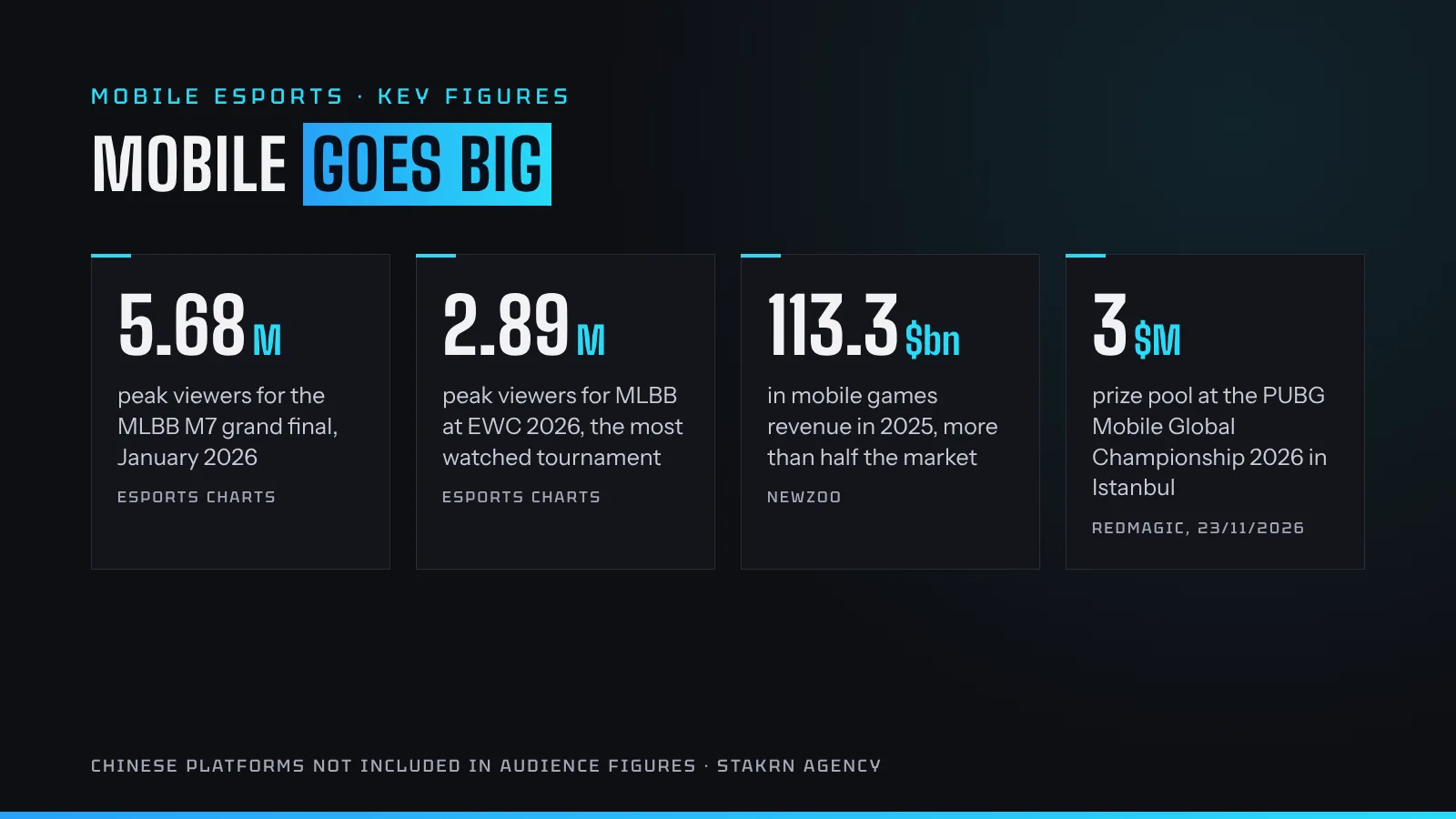
On 23 November 2026, REDMAGIC announced that it would be the official smartphone of the PUBG MOBILE Global Championship 2026, the season's world final organised by KRAFTON and Level Infinite. The event takes place in Istanbul from 11 to 13 December: 16 teams, three days of matches and a $3 million prize pool. Just another deal in the sponsorship calendar? Not really. It comes at a time when mobile esports draws audiences that many PC titles no longer reach, and when its biggest competitions are moving closer to Europe. Here is what it says about the market, and what a brand can take from it.
An endemic sponsor at the heart of the PUBG Mobile final
According to REDMAGIC's press release, the gaming smartphone brand, founded in 2018 and present in 50 countries and regions, will showcase its REDMAGIC 11S Pro during the competition. The message is all about performance: 144 Hz display, shoulder triggers, built-in cooling fan, 7,500 mAh battery. The value of the contract has not been disclosed.
The choice is no accident. In a mobile final, every pro player holds the device for hours, in close-up on screen. For a manufacturer, it is hard to dream of a better product demonstration. This is the logic of endemic sponsorship, where the brand's product directly serves the game: peripherals, computer hardware, energy drinks and, of course, smartphones. We described these partner profiles in our article on esports sponsorship opportunities for brands.
REDMAGIC is not alone in this space. In January, MOONTON announced that realme was joining Visa and Red Bull among the partners of the Mobile Legends: Bang Bang ecosystem (MOONTON press release). Mobile therefore attracts advertisers well beyond the circle of gaming brands, all the way to payment services.
Mobile, the main screen of global esports
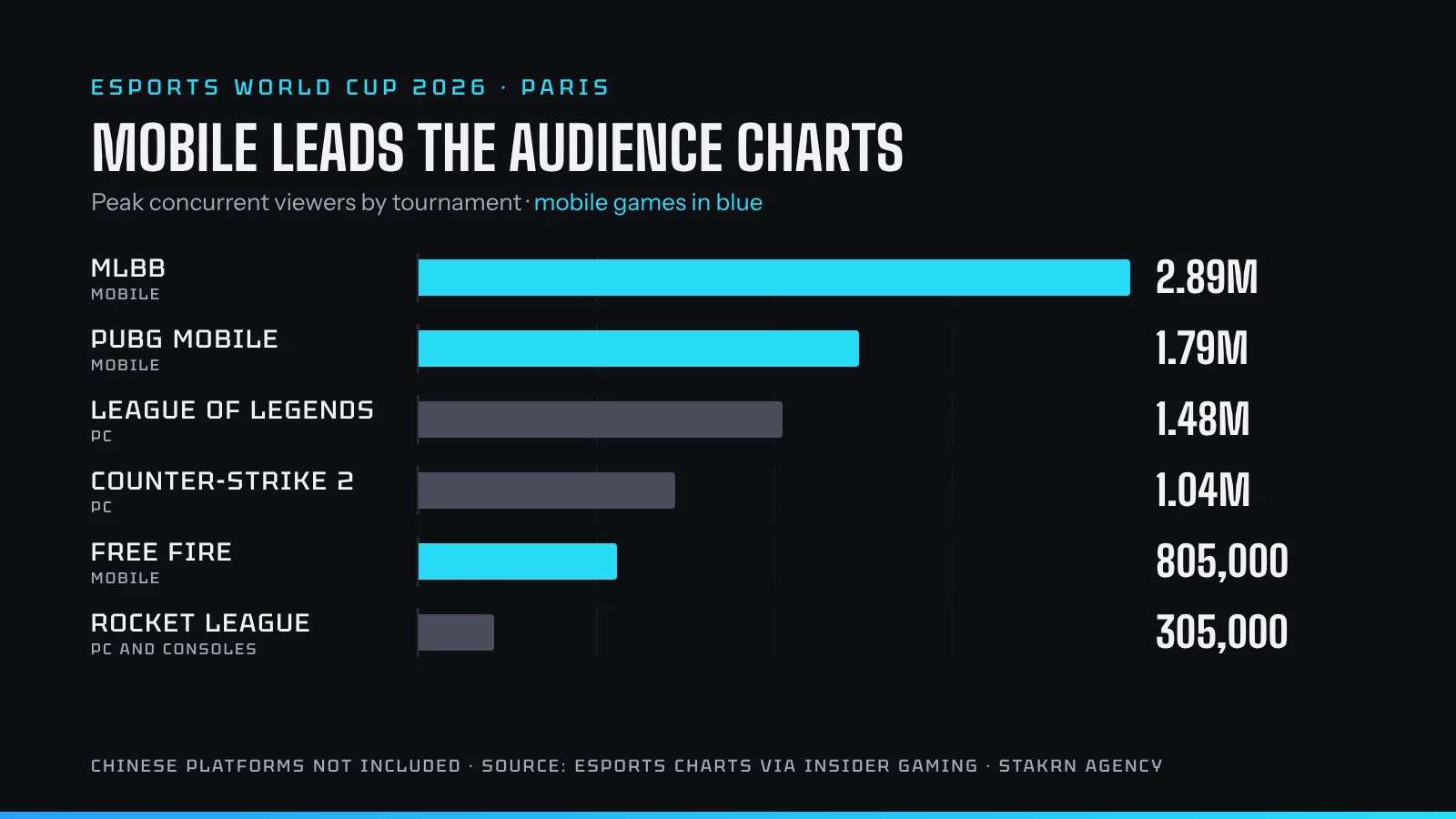
The Esports World Cup 2026, moved to Paris because of the conflicts in the Middle East, offered very concrete proof. According to Esports Charts data reported by Insider Gaming, only four tournaments passed one million concurrent viewers. The top two were mobile: the MLBB Mid Season Cup peaked at 2.89 million viewers, followed by the PUBG Mobile World Cup at 1.79 million. League of Legends came next with 1.48 million, then Counter-Strike 2 with 1.04 million. MLBB was also the most watched event of the competition by volume, with 45.27 million hours.
The trend goes beyond the EWC. In January 2026, the grand final of the MLBB M7 World Championship in Jakarta peaked at 5,680,511 viewers, according to Esports Charts as quoted by Esports.net. The tournament broke the mobile esports viewership record held since 2021 by the Free Fire World Series, and totalled 135.6 million hours watched. On the PUBG Mobile side, the 2025 Global Championship had reached 1.3 million peak viewers (Players, Esports Charts data).
A word on method: these measurements exclude Chinese platforms. For Honor of Kings, whose audience is mostly in China, the published figures therefore clearly underestimate reality. Our article on Tencent's 15 million invested in Honor of Kings shows the scale of that ecosystem.
A market worth more than half of the video game industry
These audiences rest on a solid economic base. According to Newzoo, quoted by PocketGamer.biz in June 2026, the global games market reached $201.6 billion in 2025. Mobile accounts for $113.3 billion of that, more than half, up 10.7% year on year. Newzoo expects it to reach $121.1 billion in 2026. In Europe, the firm notes 15.5% growth in mobile revenue.
Publishers can count on huge player bases. MOONTON claims more than 1.5 billion installs and 110 million monthly active users for MLBB. Its 2026 roadmap targets more than 70 regions, over 5,000 events and 600 million hours watched. These goals were set by the publisher itself and should be read as such.
Before building a plan, it pays to know where your audience is. Mobile esports remains highly concentrated in Southeast Asia, Latin America, the Middle East and India, a market we studied in our focus on esports in India. Targeted market research keeps you from sponsoring an audience that will never buy your products.
Europe joins the map: Istanbul, then the M8
For a long time, a European brand could watch mobile esports from a distance. That time is ending. After the PMGC 2026 in Istanbul in December, the MLBB M8 World Championship will be held in Türkiye in January 2027: the first M Series edition played in Europe, with a Wild Card stage in Thailand. MOONTON has also reorganised its circuit into five regions, including an EMEA zone.
For an advertiser, this changes the maths. Time zones become compatible with a European audience. Bringing in creators or setting up an on-site activation also costs far less than in Jakarta, where the M7 took place. The remaining question is whether to aim for a global or a local presence, a choice we covered in our comparison of local and international esports sponsorship.
What esports strategy for a brand on mobile?
First observation: mobile esports audiences have to be read language by language. At the M7, Indonesian-language broadcasts peaked at 3.85 million viewers and Tagalog broadcasts at 1.36 million, according to Esports Charts. A brand is better off choosing its markets before its tournaments, then the broadcasters and casters who speak to those audiences.
Second observation: broadcasting increasingly goes through social media. At the same M7, TikTok streams reached nearly 2.5 million peak viewers. An audience that watches a tournament on its phone also follows creators on that same phone. We described this shift in our analysis of TikTok LIVE and gaming streaming. Co-streaming by creators and short formats shot around the finals extend an official partnership at a lower cost.
Finally, for a non-endemic brand, mobile offers an easier way in than it might seem. Visa and Red Bull have understood this. It still takes an angle the community finds credible, such as in-game rewards or challenges between creators. A sponsorship with no link to the game goes down badly with these audiences. Before signing, ask yourself the questions in our article is esports profitable for sponsors?, and set your indicators from the brief: peak and average viewers during your segments, hours watched by language, clicks, promo codes redeemed.
Conclusion
REDMAGIC's deal with the PMGC 2026 illustrates a deeper trend. Mobile esports now draws the biggest audiences in the discipline, rests on half of the games industry's revenue and is bringing its finals to Europe's doorstep. Smartphone makers saw it first. For other brands, the window is open. Provided they choose their markets before their tournaments, and measure what each activation really delivers.
Thinking about sponsoring mobile esports?
Contact us today to discuss it. Since 2016, STAKRN Agency has supported brands in esports and video games: more than 100 clients and 250 campaigns. As an esports agency and gaming agency, we represent 47 talents and, for each project, select the creators whose audience matches your target.
Just one thing to do: fill in the form below.
STAKRN Agency is neither affiliated with nor a partner of KRAFTON, Level Infinite, MOONTON or REDMAGIC.
Written by the STAKRN Agency team
Esports, gaming and influence agency since 2016: strategic consulting, talent management and influencer campaigns.